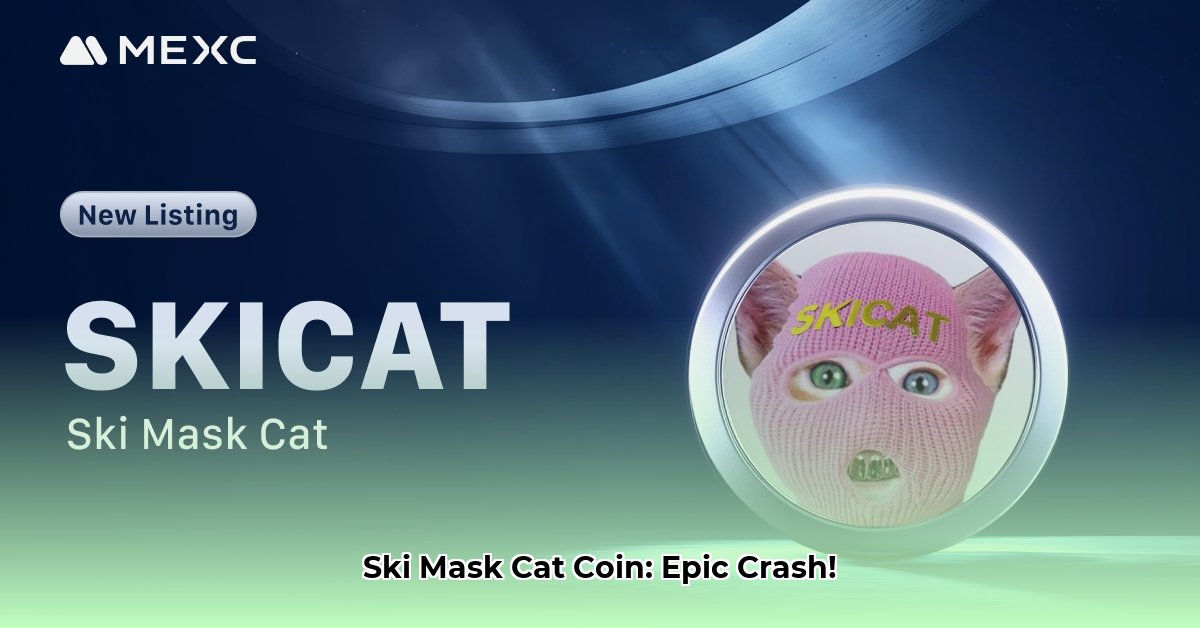
Ski Mask Cat Coin's 7-Day Price Dive: Unraveling the Mystery
The Ski Mask Cat (SKICAT) cryptocurrency experienced a significant price decline between February 11th and 18th, 2025, plummeting approximately 30% according to estimates from CoinGecko and CoinMarketCap. This sharp drop raises questions about the coin's underlying stability and the factors contributing to its volatility. The discrepancy in reported figures between these tracking platforms, potentially stemming from differing data collection methodologies, highlights a broader issue: the lack of transparency surrounding SKICAT's metrics. Is this a harbinger of wider instability within the meme coin market segment?
The Mystery of Inconsistent Supply and Low Trading Volume
One of the key challenges in understanding SKICAT's price crash stems from inconsistencies in its reported circulating supply. Variations across different cryptocurrency data aggregators raise concerns about the accuracy and reliability of available information. This ambiguity makes valuing SKICAT objectively challenging, similar to appraising a property without knowing its precise dimensions. Adding to this difficulty is the unusually low daily trading volume, hovering around $1 million. Such low liquidity makes SKICAT exceptionally vulnerable to price manipulation, even from relatively small trades – a situation akin to a small boat being easily tossed around in a large storm.
Base Blockchain Interdependence: A Shared Fate?
SKICAT resides on the Base blockchain, a layer-2 scaling solution for Ethereum. This interconnectedness means SKICAT's performance is intrinsically linked to Base's overall health and market sentiment. Any negative news or downturn affecting Base could directly impact SKICAT's price. However, was this recent crash primarily a reflection of broader market trends, or were there SKICAT-specific triggers at play? This remains a key area of ongoing analysis. Did a general lack of confidence in the Base ecosystem lead to a cascade effect, impacting SKICAT disproportionately?
Navigating the Risks: A Stakeholder Perspective
The situation demands a careful assessment of risk and the development of appropriate mitigation strategies for all stakeholders. The following table outlines immediate and long-term considerations:
| Stakeholder | Short-Term Actions | Long-Term Considerations |
|---|---|---|
| SKICAT Holders | Diversify holdings; monitor SKICAT price closely; consider stop-loss orders. | Evaluate SKICAT long-term potential; assess community growth & project alignment with investment goals. |
| Cryptocurrency Exchanges | Enhance risk assessment for SKICAT; review listing criteria. | Implement stricter listing policies; prioritize transparency and reliable information for new coin listings. |
| Base Blockchain Developers | Promote ethical trading practices & transparent data reporting. | Improve data accessibility & enhance market stability through robust mechanisms. |
| Regulators | Monitor the market for irregularities and potential manipulation. | Develop clearer regulatory frameworks for meme coins and lesser-known cryptocurrencies. |
Risk Assessment Matrix: Understanding the Potential for Future Losses
The following matrix outlines the primary risks associated with SKICAT and potential mitigation strategies:
| Risk Factor | Likelihood | Impact | Mitigation Strategies |
|---|---|---|---|
| Extreme Price Volatility | Very Likely | High | Diversify investments; utilize stop-loss orders; employ dollar-cost averaging (DCA). |
| Lack of Transparency | Very Likely | Moderate | Demand increased transparency from the SKICAT team; research thoroughly before investment. |
| Low Trading Volume | Likely | Moderate | Only invest amounts easily absorbed by potential losses; assess community engagement and trading activity growth. |
| Regulatory Uncertainty | Likely | High | Stay updated on cryptocurrency regulations and adapt investment strategy accordingly. |
| Dependence on Base Blockchain | Possible | Moderate | Monitor Base blockchain's performance and stability; assess overall ecosystem risks. |
How to Mitigate Risks Investing in Low-Volume Meme Cryptocurrencies
The SKICAT event serves as a stark reminder of the inherent volatility of low-volume meme coins. The significant 7-day price drop underscores the speculative nature of such assets. While identifying the precise cause remains challenging, the incident highlights the crucial need for effective risk management strategies.
Key Takeaways:
- Meme coins are exceptionally volatile due to their reliance on hype and speculation.
- Low trading volume amplifies risk, making price manipulation easier.
- Diversification is key to managing risk within a cryptocurrency portfolio.
- Stop-loss orders are pivotal in limiting potential losses.
- Dollar-cost averaging allows for steady investment regardless of price fluctuations.
- Thorough due diligence, researching the underlying project, team, and community involvement, is essential.
Practical Steps for Risk Mitigation:
- Diversify: Spread investments across multiple cryptocurrencies and asset classes.
- Stop-Loss Orders: Set automatic sell orders to limit losses.
- Dollar-Cost Averaging (DCA): Invest fixed sums periodically.
- Stay Informed: Monitor market trends and news related to SKICAT.
- Due Diligence: Thoroughly research the project's fundamentals.
- Risk Assessment: Only invest what you can afford to lose.
- Realistic Expectations: Accept the possibility of losses.
The meme coin market is dynamic, and while attractive to many, understanding the risks and employing appropriate mitigation strategies is crucial for success. By remaining informed and adopting a measured approach, investors can navigate this volatile landscape more effectively. The experience with SKICAT offers valuable lessons in the importance of due diligence and risk management in the cryptocurrency space.